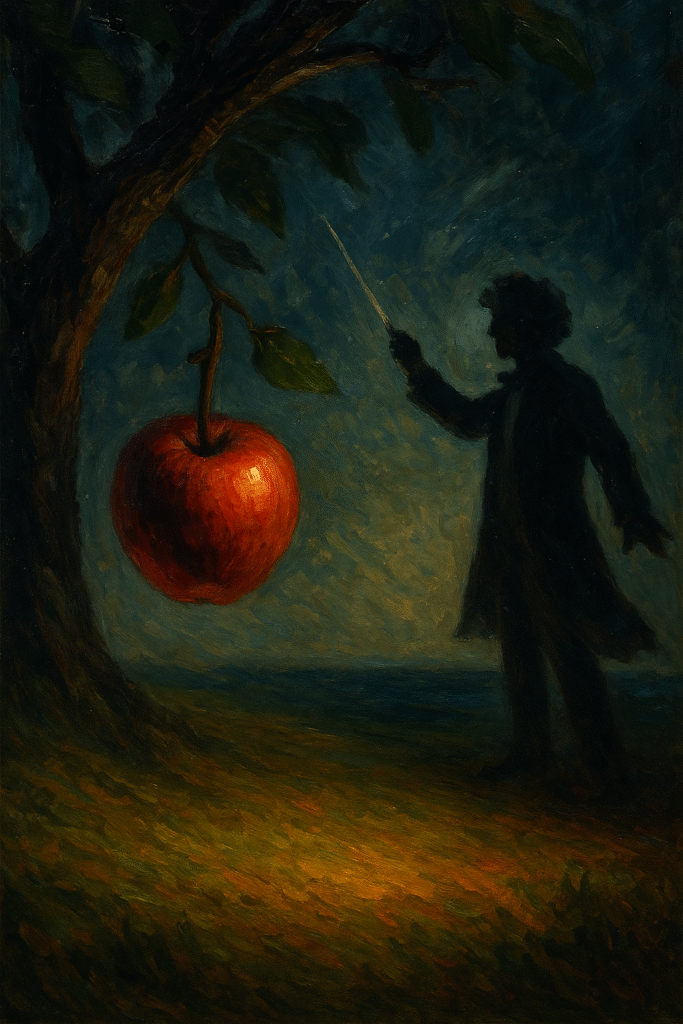
Falls, Maestrois a reminder of the facts of life — the unchangeable truths that shape us. It nods to the apple in the garden, the apple that dropped for Newton, and the very roots we come from. These are not moments we can bargain with or undo; they are set pieces in the human story.
Yet here, the “maestro” conducting it all becomes more than just a symbolic figure. Is it the one orchestrating nature’s laws, or is it a stand-in for the teacher, the guide, the one who presents the “truth”? And if so, how much of that truth is to be trusted?
Like a multiple-choice question — True, False, A, B, C, or D? — the song invites us to consider not just the facts before us, but the credibility of the voice that frames them. Even the most authoritative baton can waver, and so the listener is left to weigh not only the lesson, but the one delivering it.
Lyrics – Falls, Maestro
the apple, the words your blade the shade
the tree, your spree your glee, of me
It falls, maestro it falls maestro it falls maestro it falls
the world, it’s round your words they sound pierce like steel it cuts, not kneel
It falls, maestro it falls maestro it falls maestro it falls
*”Space that there Moments like days Lime like that
In Meadows*
For meadows, for meadows, for meadows…
Tropeless craze – Moments like years Lime sapped yews
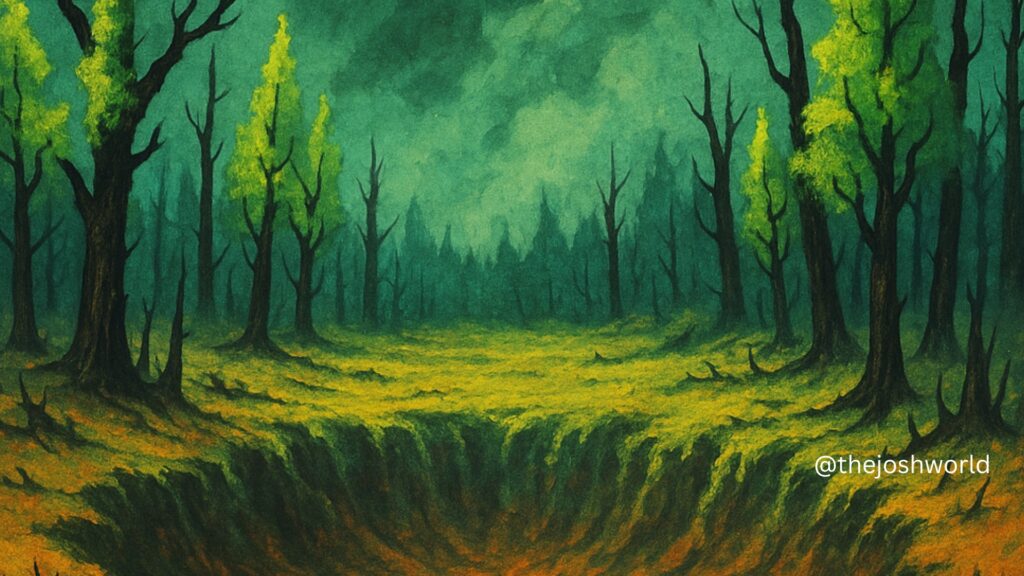
“Meadow Fallen Plain” is the latest in my meadow/pasture-themed works — a continuation of the thread woven through pieces like Bright Pastures and Ocean Meadows. On the surface, it reads like an ode to nature: an observation of landscapes, trees, and the delicate balance they hold. Having visited roughly 70% of the national parks in the U.S., I’ve seen firsthand the beauty and fragility of these places — from vast plains to hidden groves — and I’ve carried those experiences into my writing.
But Meadow Fallen Plain is more than pastoral imagery. In the phrase “lime sapped yews”, there’s a subtle tension: trees that have stood for hundreds of years can be undone in a single moment — by fire, by storm, or by forces far more destructive. The imagery here isn’t far from a nuclear aftermath — a meadow that once held life and movement, now silent, flattened, and changed forever.
The song’s refrains — “Moments like days” and “Moments like years” — capture the strange elasticity of time in such events. A long stretch of peace can end in an instant. A single moment can stretch endlessly in memory. Nature, like life, can be both enduring and heartbreakingly fleeting.
It’s a reminder of stewardship — to protect what we have while we can — but also an acknowledgment of inevitability. Not everything survives, no matter how long it’s stood or how deep its roots reach. In that way, Meadow Fallen Plain is both a love letter to nature and an elegy for it.
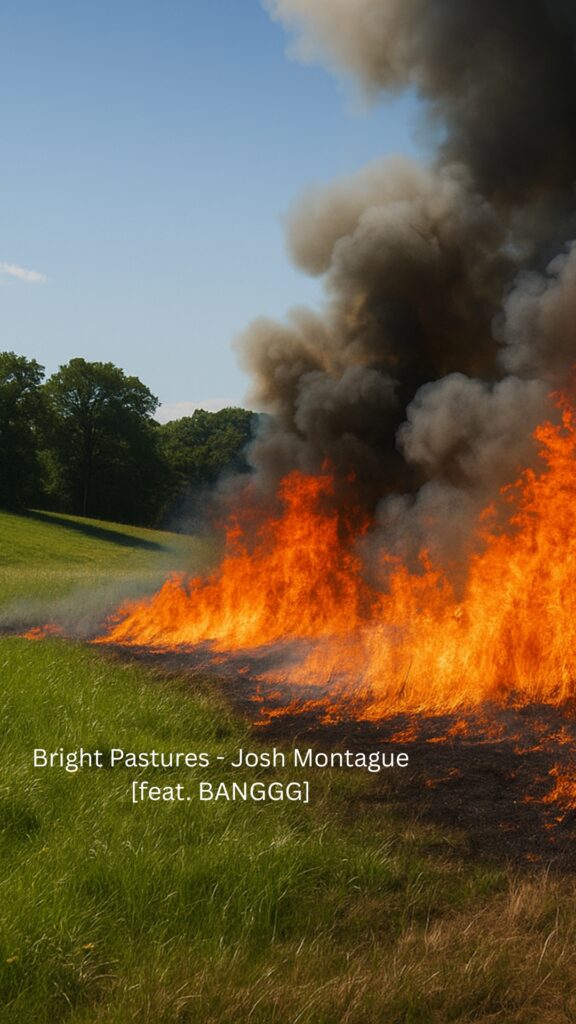
In agriculture, it’s common for farmers to burn grasslands intentionally — a controlled fire that revitalizes the soil, making it more arable for future growth. Yet, that practice comes with risk. A wrong wind, a moment of miscalculation, and the blaze can consume trees, harm livestock, or even destroy the very grain that was meant to be nurtured.
Bright Pastures takes that reality and flips it into a metaphor about human nature — how some people seem almost drawn to disrupting good things. Some do it without thought, others with deliberate intent. Like a fire started in fertile fields, their actions can spread, damaging not only what’s in front of them but everything connected to it.
Interestingly, this track follows my recent release Ocean Meadows. While that song pondered the space we make (or deny) for others, Bright Pastures almost feels like its opposite — a burning meadow finding immediate peace only in its aftermath. I didn’t plan it that way, but the thematic connection revealed itself after the fact.
Lyrics – Bright Pastures
bright pastures people seem to burn
bright pastures people seem to burn
the arable, the land that fills people people seem to yearn
the arable, the land that fills people people seem to yearn
instrumental
the pock, the flock, the driven nock people people seem to churn
the pock, the flock, the driven nock people people seem to churn
bright pastures people seem to burn
bright pastures people seem to burn
the butter wings flutter lings of fowl, fowl, smoke
the butter wings flutter lings of fowl, fowl, fowl, fowl, fowl, smoke
The song layers rustic imagery over a deeper commentary — a reminder that even in the most fertile, vibrant spaces, there’s always the risk of destruction from within.
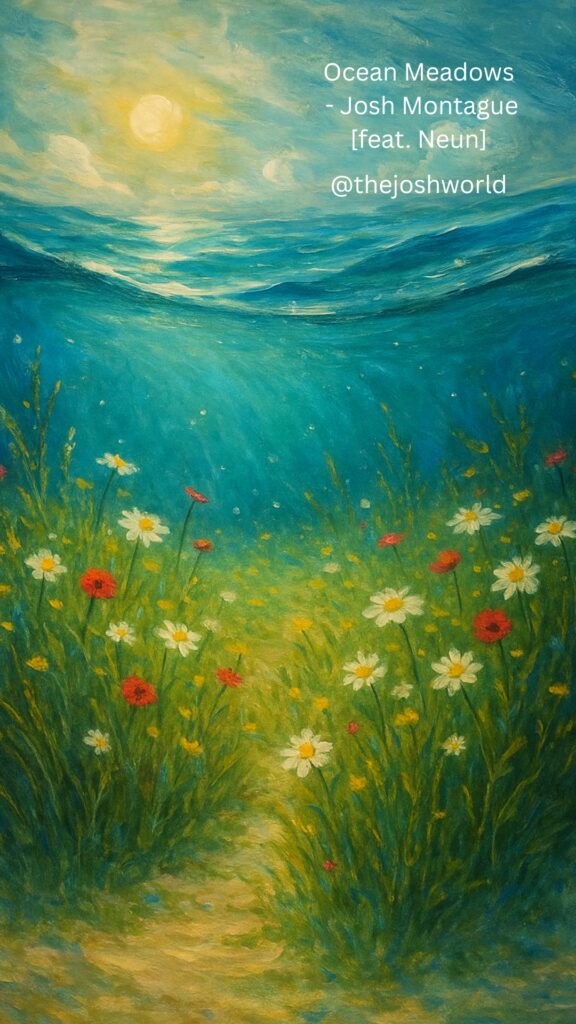
“Ocean Meadows” is one of those songs where the lyrics are deceptively simple, yet quietly loaded with meaning. The imagery itself is a contradiction—there are no meadows in the ocean. Is it satire? Is it a wishful imagining, as if meadows really could exist beneath the waves? Or is it simply a symbolic pairing meant to spark your own interpretation? That’s for you to decide.
What is clear, however, is that there is a “space.” It’s a healthy reminder to make space for others—something the world so often refuses to do, whether in physical, emotional, or even digital realms like social media and YouTube. Sometimes, it’s not strangers who deny space, but family. To me, if anything, the song means that I would make space for you, even when others would not. Perhaps the strange pairing of “ocean” and “meadows” underscores the hypocrisy of the way the world can be—how people and systems refuse what should be basic rights.
I’m reminded of the well-known story about the most prominent religious figure in history, Jesus—how there was no space for his birth at the inn, and he was instead delivered in a stable, placed in a manger. Not to come across as overly religious here, but simply as an analogy: even in a world that should have made room, there wasn’t, and yet a place was still made.
And just as man came into the world nearly lacking space, so might one leave it the same way—the ocean itself making space for ashes carried off into it, as if the ocean of meadows bears a space like a grave.
So whether “Ocean Meadows” makes you picture something real, impossible, or deeply personal, its simplicity holds room for your own meaning. That space is there—if you want it.
—Josh Montague
Lyrics:
Like the meadows in the ocean like the meadows in the ocean
there’s a space there’s a space
Like the meadows in the ocean like the meadows in the ocean
I’m excited to share “Those Days”, my newest studio version release featuring LXV — a track that lives somewhere between nostalgia, fading memory, and quiet reflection. This version offers a more polished production than some of my previous, rawer works, but it still retains the minimalist emotion and tone I’ve come to rely on.
It’s a song about change — the subtle, inevitable kind. The kind that doesn’t arrive with a warning but quietly replaces the familiarity of now with the distance of then. It’s about lawns once green, days once long, moments that no longer return. Even if you believe in restoration, in God, or in some divine order — the reality remains: life never repeats itself exactly. What we call “those days” can’t be relived. And maybe that’s why we hold them so dearly.
This studio version brings those themes forward in a way that feels more final — but not without beauty.
Lyrics – “Those Days”
bright row
sun shade
sun rise
sun daze

days long
lawn gone
green cut
auds fawn

those days
those days
are gone
are gone

those days
those days
are gone
are gone

L's lost
snow blue
ice cold
might cue

long lost
rind spans
of F lawns
end lands

those days
those days
are gone
are gone
This release joins a small but growing group of studio versions I’ve put out this week. If you’ve been following my work, you’ll know many of my earlier pieces were written and recorded with only a phone — improvised, raw, and as real as it gets. But these new versions bring clarity to the emotional undertones I’ve always tried to convey.
This guitar instrumental began with the artwork — not of a real desert, but one that could never exist. Saturn, a gas giant, has no solid surface… and certainly no sand. And yet, in the art piece I created alongside this instrumental, a soft mirage of dunes stretches under a Saturn-like sky — adrift to one like even our own, that shimmer with illusion.
That’s the idea behind this song.
We often rely on what feels familiar — dunes, hills, the illusion of ground. But Saturn reminds us that not all that appears solid truly is. The universe, like life, is full of shapes and symbols we think we understand… until we look closer.
This track is about that illusion. About how even emptiness can appear inviting, how we sometimes chase the familiar instead of facing what’s real. Because like Saturn’s “airsand,” what looks grounded from afar may vanish when you try to stand on it.
The latest lyrical song I’ve released is titled “Haps of Icebergs, Mis” — an enigmatic track that alludes to the haunting complexity of Europe’s tangled past. In this piece, I wanted to explore, both subtly and starkly, the origins of disorder and empire: from the seemingly chaotic tribes of early Europe to the legacy of dynasties that shaped the modern world.
When I first studied European history, I was fascinated by the Hapsburgs and the Holy Roman Empire. There was a mystique to it — something almost ghostlike. The HRE was neither holy, nor Roman, nor an empire in the traditional sense, and yet it held influence for centuries. Today, the name Hapsburg rings quietly, with very little trace left in modern mainstream discourse. And yet… how could they not have been central to the narratives that spiraled into World War I and II?
The lyrics in this song start with an almost chant-like repetition:
the manic tribes of jerrs and vibes of hay *(e) —–
There’s something purposefully obscure in these lines. “Jerrs” and “vibes” reference not only sonic cues, but cultural reverberations — the manic undercurrent of Europe’s tribal past, particularly the Germanic tribes that, long before forming nation-states, roamed with warlike cadence. Those very tribes, from the Goths to the Vandals, were painted in historical texts as destroyers, often unfairly reduced to caricatures of chaos and destruction. And yet, were they not the foundations of the continent?
oras of haze hours of the daze
This portion bridges to something more psychological, more metaphysical. The “hay” becomes “haze”, and with that subtle vowel shift, we move from a scene of rustic simplicity to one of mental fog — “hours of daze”, or perhaps, days of daze. That confusion, that dazed haze of history, is what this song sits within.
veux to veux of lieu to lieu to stay
French listeners may recognize “veux” (want) and “lieu” (place), hinting at movement, longing, belonging — even a fragmented identity. I myself am predominantly British, though my bloodline traces back to Normandy, France around 800 AD, and still, there’s significant German descent woven in. In this way, the song becomes not just about nations and histories, but personal inheritance: where do we belong in the lines drawn by centuries before us?
The song repeats again:
the manic tribes of jerrs and vibes of hay *(e) —–
And it’s worth noting — some lines were intentionally left out. Maybe one day I’ll share the missing stanzas. Maybe some of the meaning is best left for interpretation.
Lastly, I want to touch on the title. Haps of Icebergs, Mis — a play on “Hapsburg” and “mishap” and the coldness of icebergs. The things we only see the tip of. What lies beneath?
This piece is not a straightforward telling. It’s not a lesson, not even a clear narrative. But it is a meditation on history, identity, power, and perhaps the absurdity that comes from trying to find order in centuries of disorder.
Thanks for listening. I suppose it isn’t the end. Not yet.
Some songs emerge not with a bang, but with a kind of quiet finality — not loud, not sprawling, but still deeply felt. “Close, what?” might be that kind of song.
At just around a minute and a half, this piece is ominous, minimal, and draped in questions. It offers a hint of closure without ever confirming it. It might be the final piece in this small collection of lyric-based recordings I’ve made. Or maybe not. It feels like it, though.
The song unfolds in short, shadowy stanzas, with a sense that something — something important — is being sought, and maybe even found:
There are times when we must go there to find
There are times when we must go there to find
when we get there we, we know, what we’re there to find
the end
It reads like a riddle — or an answer you didn’t know you were asking for. If there’s an epiphany buried in it, it may dawn gently — or not at all — depending on the listener.
I’ve released nine lyrical songs in this raw, minimalistic style — recorded simply, with nothing but an iPhone, guitar, and my voice. Of those, five to eight may form a short project or album. I haven’t decided whether all nine will be included, or if I’ll revisit them one day in fuller, more studio-crafted versions.
But this version is theoriginal. The first draft. The unsanded edge.
For now, Close, what? feels like a good place to stop — at least for a moment. If it is a closing, it’s not dramatic. It’s just… final. If it isn’t, it’s a doorway. One you didn’t know you passed through.
Sometimes life places us not in the aftermath, or even the beginning, but in the middle — in the unseen moment where things shift but haven’t settled. That’s where this new short song came from.
“Between Light & Dark, Places” is only just over a minute long. It opens with a rhythm of soft, triadic guitar figures — a brief but steady pattern I built out of improvisation, something both calming and quietly unsettled. Then come the words. Sparse, but weighted.
when the darkness fades and the sunlight shades it’s a blackness of none of it
The lyrics repeat — like something unresolved. It’s meant to capture the emotional limbo we often find ourselves in. Not fully healed. Not fully broken. A passenger between the weight of cosmic forces — or, more realistically, the motivations and consequences of other people’s decisions. Their wars. Their actions. Their decisions, & the effect it has on us.
Something In the Nothing
Even in what feels like nothing, there is something. Maybe not a reason, maybe not a plan — but presence, even in shadow, absence. A whisper of weight in a moment of pause. That’s what I wanted this song to live in — the gray, the in-between, the places between light and dark.
In a world increasingly dominated by noise and reaction, quiet reflection becomes an act of resistance. And this piece, small as it is, was my way of pushing back — even if only for a minute.
Some songs don’t offer answers — only questions with echoes. My new song, ‘Non, e‘ drifts in that kind of space.
Built around a minimal progression and a vocal loop, this song leans into something mystic and slow-burning — a meditation on what remains present even in absence.
The lyrics are simple:
in the darkest days there’s time and space
in the realm of none there’s nothing to be done nothing to say in time or space
It circles these lines — not to resolve them, but to let them resonate. Because even on our darkest days, something still exists: time still ticks. Space still stretches. And in that, there’s both grief and possibility.
Parallels with the Universe
The song touches on something more cosmic — how the scaling nature of the universe feels eerily parallel to our emotional lives.
The universe expands. It accelerates. Scientists still ask whether that expansion will go on forever, or whether one day it’ll hit a final wall — entropy exhausted — what I’ve jokingly called before: The Big Brick.
Will there be something beyond that point? Or will it stretch endlessly toward a realm of none — of zero — where nothing more can be done or said?
These are huge questions, yes, but this song doesn’t try to answer them. It just holds them quietly, like a sky on mute.
A Space for the Listener
‘Non, e‘ isn’t loud. It doesn’t build to a drop or a resolution. It’s a slow shimmer. And sometimes that’s what’s most honest — music that gives you space to think, not just something to fill it.